Speed · Power · Execution
Most athletes don't lack effort. They lack a structure that tells them what to do on Tuesday, why it comes after Monday, and how to know it's working. Winning Command is that structure — written down, in order, week by week.
Instant access. Works on a phone in a gym.
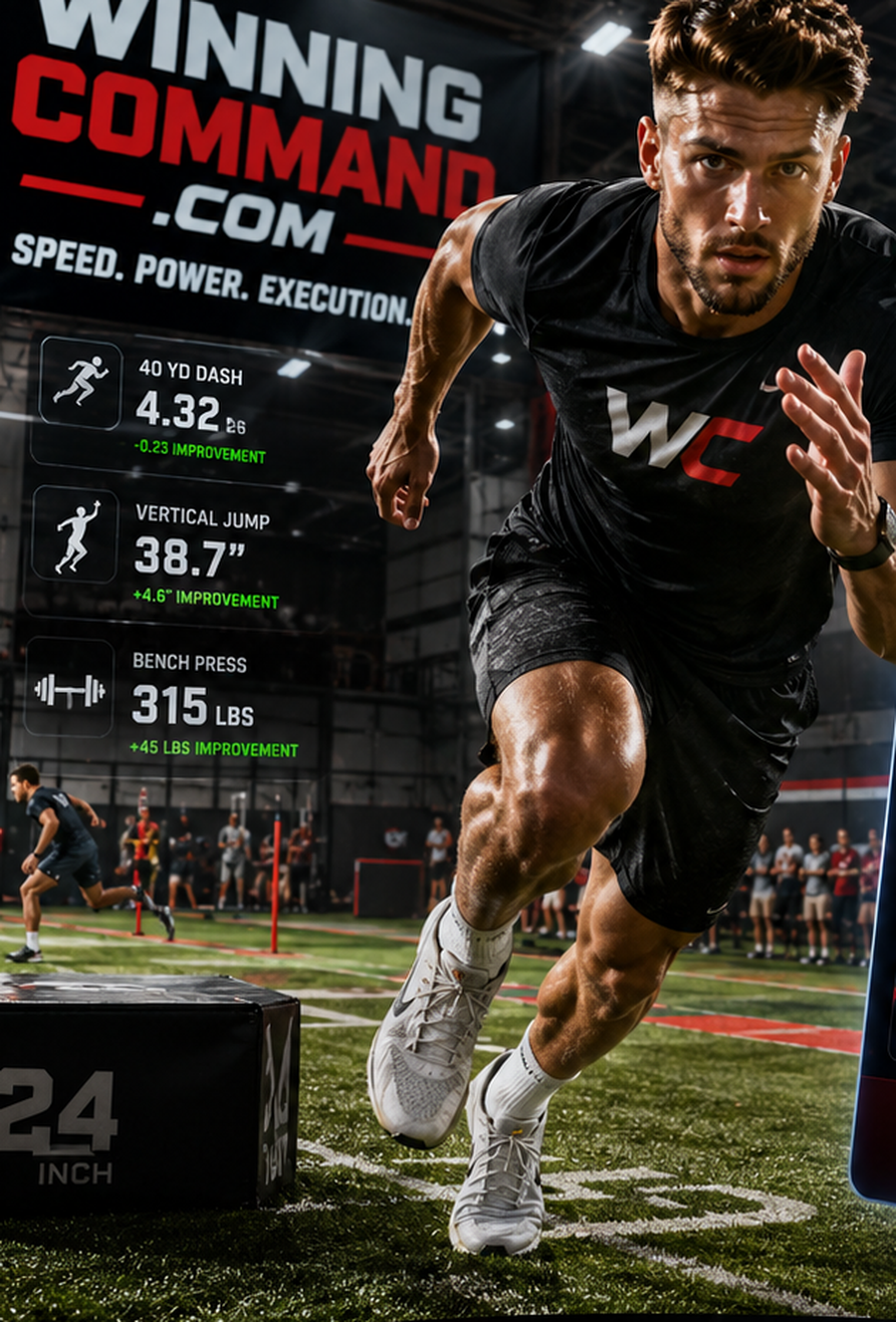

The Real Problem
You've watched the videos. You've saved the drills. You've got a folder of screenshots you've never opened twice. On any given day you can train hard — what you can't do is tell anyone what you're building toward, or how this week connects to last week.
That's not a discipline problem. It's a programming problem. Effort without sequence burns you out and leaves you flat on the days that actually count.
A plan solves it. Not a harder plan — an ordered one, where each block has a job, the load moves in a direction, and you can see whether it's working without guessing.
What It Covers
Every block in the program maps to one of these. Nothing is in there because it looked good.
Acceleration and top-end mechanics, drilled in the order they actually develop.
Progressive loading built around the lifts that carry over to your sport.
Jump and throw work programmed for quality, not volume for its own sake.
Pre-session routine, focus under fatigue, and how to train on the bad days.
Sleep, load management and deload weeks treated as part of the work.
The scheduling and tracking habits that keep a plan alive past week three.
The Difference
How It Works
1. Set your baseline. Simple tests you can run yourself, so every number later has something to be compared against. Takes one session.
2. Pick your block. The program is organised into blocks by what you're building — early season, in season, off season, or general athletic base. You start where you actually are.
3. Run the weeks and log them. Each week is written out. You follow it, record what you lifted and ran, and the tracker shows you the direction of travel.
Nothing here requires a facility most people don't have. If you have access to a barbell, some space and a clock, you can run it.
Everything In The Package
Full written training system across all six pillars, organised into blocks with week-by-week sessions.
The exact tests, how to run them consistently, and where to record them.
A simple log for sessions and test numbers so you can see direction rather than guess at it.
Warm-up, main work and finisher structures you can reuse when you need to build a session yourself.
Pre-session routine, refocusing under fatigue, and handling the weeks that don't go to plan.
How to schedule lighter weeks on purpose, and what to watch for that says you need one early.
Honestly
It's for a committed athlete who already trains and wants the structure to make that training add up — someone who'll follow a written week even when they don't feel like it.
It isn't for anyone looking for a shortcut, and it isn't a substitute for coaching on your actual sport skill. It's the physical preparation underneath that.
If you're carrying an injury or a medical condition, speak to a qualified professional before starting any new training programme. This is a training system, not medical advice.
Full Access
One payment. Instant access. Yours to keep.
Get Instant AccessDelivered as an instant download. Works on phone, tablet or laptop.
Before You Order
It's general athletic preparation — speed, strength, explosiveness and the habits around them. It sits underneath sport-specific skill work rather than replacing it, so it applies across most field and court sports.
A barbell and plates, somewhere to run, and a clock covers the large majority of it. Where a session calls for something less common, there's a stated alternative.
The blocks are built around three to four sessions a week. There's guidance on compressing to fewer sessions when your schedule gets difficult, which it will.
The programming assumes you already train. The baseline tests set your starting loads from your own numbers, so the same block runs differently for different athletes.
Instant download after checkout. You'll land on a page with your access straight away — nothing is posted to you and there's nothing to wait for.
Yes. There's a contact address inside the members area that reaches a real person.

The athletes who pull ahead over a season are rarely the ones who trained hardest in any single week. They're the ones who ran a plan while everyone else improvised.
Start Training